
Recipe Details
Buss Up Shut Roti: A Caribbean Twist on Unleavened Flaky Layers
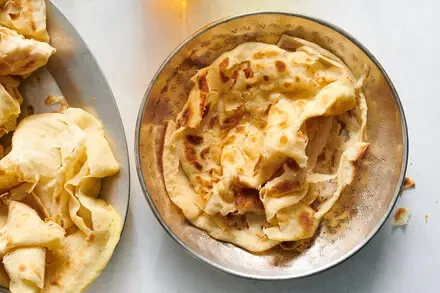
In Trinidad and Tobago, the roti known as buss up shut carries a vivid culinary narrative: its name derives from the "torn" appearance of its flaky, layered structure after the cooking process—literally, a "busted up" shirt, a result of the paratha-like layers that split gently during preparation. This version is crafted by Peter Prime, executive chef of Washington, D.C.’s Caribbean restaurant Bammy’s, and embodies the fusion of Indian culinary roots with Caribbean adaptation.
Across the globe, from the Indian subcontinent to the Caribbean Islands and East Africa, "roti" broadly describes unleavened (no-yeast), flatbreads cooked on a stovetop. Unlike some leavened varieties, buss up shut emphasizes soft, tender layers with a toasted nuttiness, achieved through a signature layering technique and careful oil brushing.
Ingredients (Serves 4)
Dough: 500g all-purpose flour (maida), 250–275ml warm water, ½ tsp fine sea salt, 1 tbsp coconut oil (for dough).
Layering Oil: 100g unsalted butter or ghee, 50g coconut oil (melted together).
Step-by-Step Preparation
1. Dough Preparation
Combine flour, salt, and warm water in a large bowl. Knead by hand for 5–7 minutes until the dough is smooth, elastic, and slightly tacky (add a splash more water if too dry). Fold in 1 tbsp coconut oil, then shape into a tight ball. Cover with a damp cloth and rest for 15 minutes to relax gluten.
2. Divide and Roll
Divide the dough into 8 equal portions (≈60g each). Working one at a time, dust a clean surface with flour and roll each portion into a 20cm circle using a rolling pin.
3. Layering Technique (Key for Flakiness)
Place a portion of rolled dough on a flat surface. Brush the entire surface generously with the melted butter/ghee-coconut oil blend, covering evenly. Fold the dough into quarters (like a book), then rotate 90°, roll again to 20cm, and repeat the oil-brushing and folding process twice more (total 3 folds per portion). This creates 16+ layers, ensuring flakiness.
4. Cooking the Roti
Preheat a cast-iron skillet over medium heat. Lightly dust the folded dough with flour and roll gently to 25cm (thinner than initial rolls to encourage layering). Transfer to the skillet. Cook for 1–2 minutes until golden spots form on the first side, then flip. Press lightly with a spatula to crisp layers, cooking 1–2 more minutes until both sides are golden-brown and layers begin to separate.
5. "Bust Up Shut" Effect
As the roti cooks, the trapped steam between layers causes gentle separation. Using tongs, lightly tear the edges to mimic the "torn shirt" look, yielding the signature buss up shut texture.
Characteristics & Serving
The finished roti features tender, chewy layers with a faint coconutty aroma and toasted richness from the butter-coconut oil blend. Serve immediately while hot to enjoy maximum crispiness and softness. For later use, cool completely, wrap tightly in parchment paper, and freeze for up to 1 month. Defrost in the fridge overnight, then steam in a covered pot for 3–4 minutes to restore tenderness.
Recipe courtesy of Peter Prime, executive chef at Bammy’s, Washington, D.C. – Yewande Komolafe
Note: Adjust oil-to-flour ratios for personal preference; ghee adds depth, while butter amplifies creaminess. The layering step is critical—skip folding, and the roti will lose its flaky "bust up" signature.