
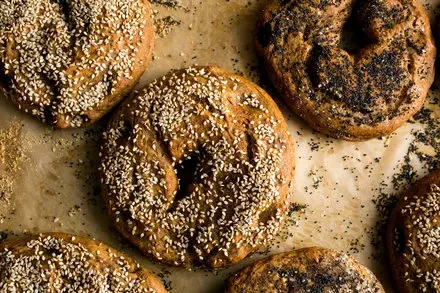
Recipe Details
Peter Reinhart’s Whole Wheat Bagels
From Bread Revolution by Peter Reinhart
Basic Information
Total Time: 4–4.5 hours (1 hour active work)
Difficulty: Intermediate
Servings: 6–8 bagels
Rating: 4/5 (273 reviews)
Comments: 31 readers have reviewed this recipe
Recipe Introduction
Peter Reinhart’s Whole Wheat Bagels, featured in his seminal cookbook Bread Revolution, redefines the classic bagel with an authentic whole-grain profile. Unlike the partially whole-wheat versions often encountered in cafes, this recipe delivers a truly whole-grain experience using either sprouted whole wheat flour (optimal for speedier fermentation) or traditional whole wheat flour (benefiting from overnight refrigeration for depth). Key to its success is Reinhart’s focus on maximizing flavor through controlled hydration and fermentation, ensuring a chewy interior and crisp exterior.
Ingredients
For Sprouted Whole Wheat Flour (Short-Rise Method):
500g (3½ cups) sprouted whole wheat flour (available at natural food stores or online)
15g (1¼ tsp) active dry yeast
10g (2 tsp) fine sea salt
20g (2 tbsp) barley malt syrup (traditional sweetener; substitute with 30g/2 tbsp honey or 30g/2 tbsp agave syrup)
350ml (1½ cups) warm water (105–110°F/40–43°C)
For Traditional Whole Wheat Flour (Overnight Method):
- Same as above, using 500g (3½ cups) regular whole wheat flour
Method
Step 1: Dough Preparation & Hydration
Combine Dry Ingredients: In a large bowl, whisk together the whole wheat flour, yeast, salt, and barley malt syrup (or substitute).
Add Warm Water: Gradually incorporate the warm water, mixing with a wooden spoon until a shaggy, slightly sticky dough forms. Critical: Whole wheat flour absorbs liquid rapidly; let the dough rest for 15–20 minutes to allow gluten development and water absorption. The dough will appear too wet initially but will firm up noticeably after resting.
Knead: Using a stand mixer with a dough hook (low speed for 8–10 minutes) or hand-kneading (10–12 minutes), develop the dough until it reaches the "windowpane stage"—it should stretch thin without tearing.
Step 2: Fermentation Variations
Option A: Traditional Overnight Fermentation (Regular Whole Wheat)
First Fermentation: Shape the dough into a smooth ball, place in a lightly oiled bowl, and cover. Proof at room temperature (70–75°F/21–24°C) for 1–2 hours until doubled in volume.
Refrigerate: Divide the dough into 6–8 equal portions (≈85g each). Shape into balls, place on a parchment-lined baking sheet, and refrigerate overnight (12–18 hours). This slow fermentation enhances flavor complexity.
Option B: Short-Rise Fermentation (Sprouted Whole Wheat)
First Fermentation: After kneading, let the dough proof at room temperature for 1–2 hours until doubled.
Shaping & Second Proof: Divide the dough, shape into bagels, and proof at room temperature for 45–60 minutes (no overnight rest). The sprouted flour accelerates flavor development, yielding a lighter, more uniform texture.
Step 3: Boiling & Baking
Preheat Oven: Set to 220°C (425°F) with a baking stone or heavy baking sheet inside.
Boiling Solution: Bring 2–3 liters of water to a boil in a large pot. Add 30g (2 tbsp) barley malt syrup (or substitute) for sweetness and chewiness.
Boil Bagels: Using a slotted spoon, gently lower shaped bagels into the boiling water. Cook 30 seconds per side, then transfer to a rack to drain.
Bake: Arrange boiled bagels on the preheated stone/sheet. Bake 20–25 minutes, rotating halfway, until golden-brown and crisp.
Key Tips
Whole Wheat Hydration: The 15–20 minute initial rest is non-negotiable for whole wheat dough—it transforms a sticky batter into a workable texture.
Sprouted vs. Regular Flour: Sprouted flour eliminates the need for overnight fermentation, while traditional whole wheat benefits from it for richer flavor.
Sweetener Balance: Barley malt imparts a subtle sweetness and depth; honey or agave work as substitutes, but reduce to 25g (1½ tbsp) to avoid overpowering the grainy profile.
This method ensures bagels with a true whole-grain character, balanced chewiness, and versatility—ideal for breakfast or as a savory base for spreads.